What billboard advertising actually costs in India
Rates for hoardings, unipoles and gantries vary by more than ten times between a small-town junction and a metro arterial road. Here is what drives the number, roughly what each format fetches, and how a media owner should price inventory rather than guess.
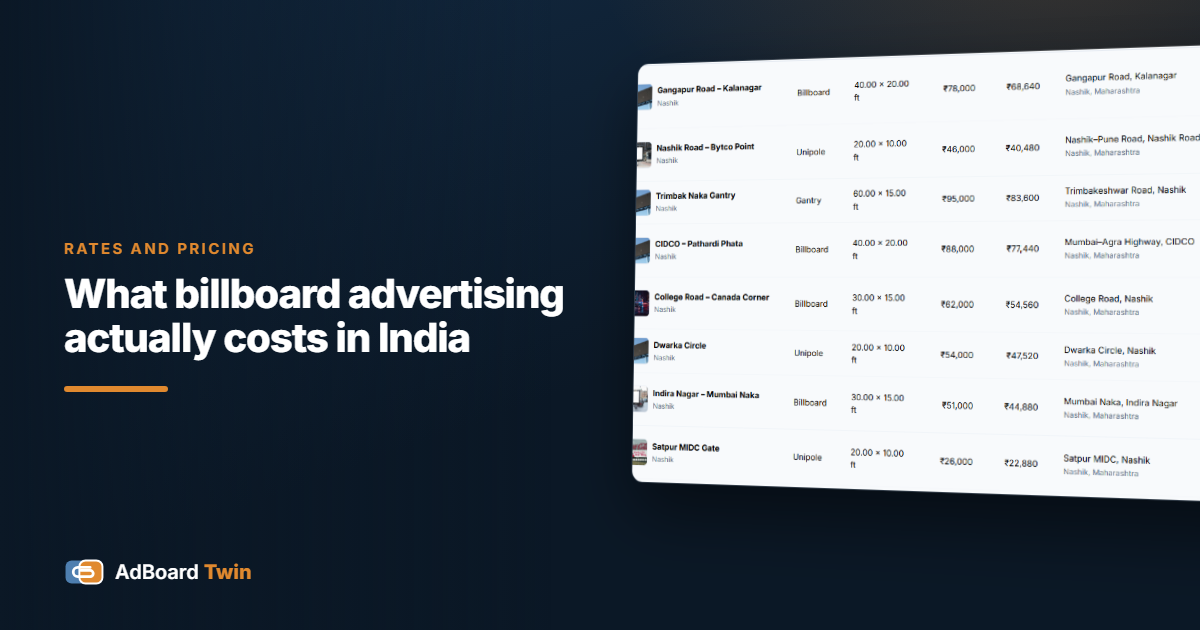
“What does a hoarding cost?” is the most common question in this trade and the least answerable in one number. The same size board fetches ₹18,000 a month at a district-town junction and ₹4,00,000 on a Mumbai arterial. Both are correct prices.
Asked another way: billboard advertising cost is not one figure but a range set by five things, and knowing which of them you are being charged for is the whole game.
What follows is how the number is actually built — useful whether you are buying space or, more to the point here, pricing your own inventory and wondering whether you are leaving money on the table.
The five things that set the rate
Traffic, and its direction. Not just volume but who is passing and how slowly. A signal where traffic stops for ninety seconds is worth more than a flyover where it passes at eighty. Facing traffic beats being passed side-on, which is why a two-faced hoarding rarely earns the same on both faces.
The catchment. A board outside a mall, a hospital or an airport approach carries a specific audience an advertiser can name. Generic footfall is worth less than a defined one.
Size and format. Rate rises with area, but not proportionally — a 40×20 does not fetch twice a 40×10. Format matters more than square footage: a gantry over the road outperforms a wall-mounted panel of the same size because there is nothing competing beside it. Size itself is only one input — what the formats are and the sizes they are built at sets the floor, not the price.
Lighting. Front-lit, back-lit or non-lit changes the number materially, because it decides whether the site sells for twelve hours a day or twenty. Back-lit commands the premium.
Permissions and clutter. A site with clean municipal permission in a corridor where new structures cannot be added is worth more than one in a stretch with fifteen competing boards. Scarcity is priced.
Rough monthly bands, India
Directional, and per face per month. Local conditions move these a long way.
| Format | Tier-2/3 city | Metro (Mumbai, Delhi, Bengaluru) |
|---|---|---|
| Wall-mounted hoarding, 20×10 | ₹15,000 – ₹40,000 | ₹60,000 – ₹1,50,000 |
| Hoarding, 40×20 | ₹40,000 – ₹1,00,000 | ₹1,50,000 – ₹5,00,000 |
| Unipole, prime junction | ₹50,000 – ₹1,20,000 | ₹2,00,000 – ₹6,00,000 |
| Gantry over carriageway | ₹80,000 – ₹2,00,000 | ₹3,00,000 – ₹10,00,000+ |
| Digital screen (shared slots) | priced per slot | priced per slot |
Treat these as a sanity check, not a rate card. If your own numbers sit far outside a band, there is usually a reason — and it is worth knowing what it is.
What sits on top of the display rate
Printing — flex or vinyl, charged per square foot, unless the client supplies their own. Mounting — labour and access equipment, more for a gantry than a wall panel. GST — state it separately on the proposal. A rate agreed without saying whether it includes tax is the single most common reason an out-of-home payment freezes months later.
How these stack up, and how agency commission sits alongside them, is covered in card rate, net rate and commission.
The mistake that costs more than the rate
Most media owners negotiate hard on the monthly figure and then lose more than the discount to vacancy. A site that sits empty eleven days between campaigns has given back more than the ten percent they refused to concede.
So the number that deserves the attention is not the rate. It is rate × days actually sold. A board at ₹78,000 running eleven months earns more than the same board held out for ₹85,000 and running nine.
That is also why what you quoted last time, and to whom matters more than the card rate. A client who was quoted ₹62,000 in March and hears ₹78,000 in September will ask why — and “I don’t have that written down” is a bad answer.
Pricing your own inventory properly
- Write down the card rate per face, not per structure. Two faces on one hoarding are two different products at two different prices.
- Record what was actually agreed, every time, against the site and the client. The negotiated rate is the real rate card.
- Track vacant days per site per year. Until it is counted, the largest cost in the business is invisible — see how many days did your sites sit empty.
- Separate rent, printing, mounting and GST on every proposal, so nothing is ambiguous when the purchase order is raised.
Where software comes in, honestly
None of the above needs software. A disciplined owner with a notebook can do it. What software changes is that the discipline stops depending on memory: the card rate and the last agreed rate sit on the site record, availability is worked out from bookings rather than maintained by hand, and the invoice is raised from the campaign so it cannot disagree with what was sold.
AdBoard Twin is out-of-home advertising management software built for media owners — billboards, hoardings, unipoles, gantries and digital screens, with the rate card, availability, proposals, proof of display and invoicing in one place. If the terms above are unfamiliar, the glossary defines them. You can open the live demo without signing up.